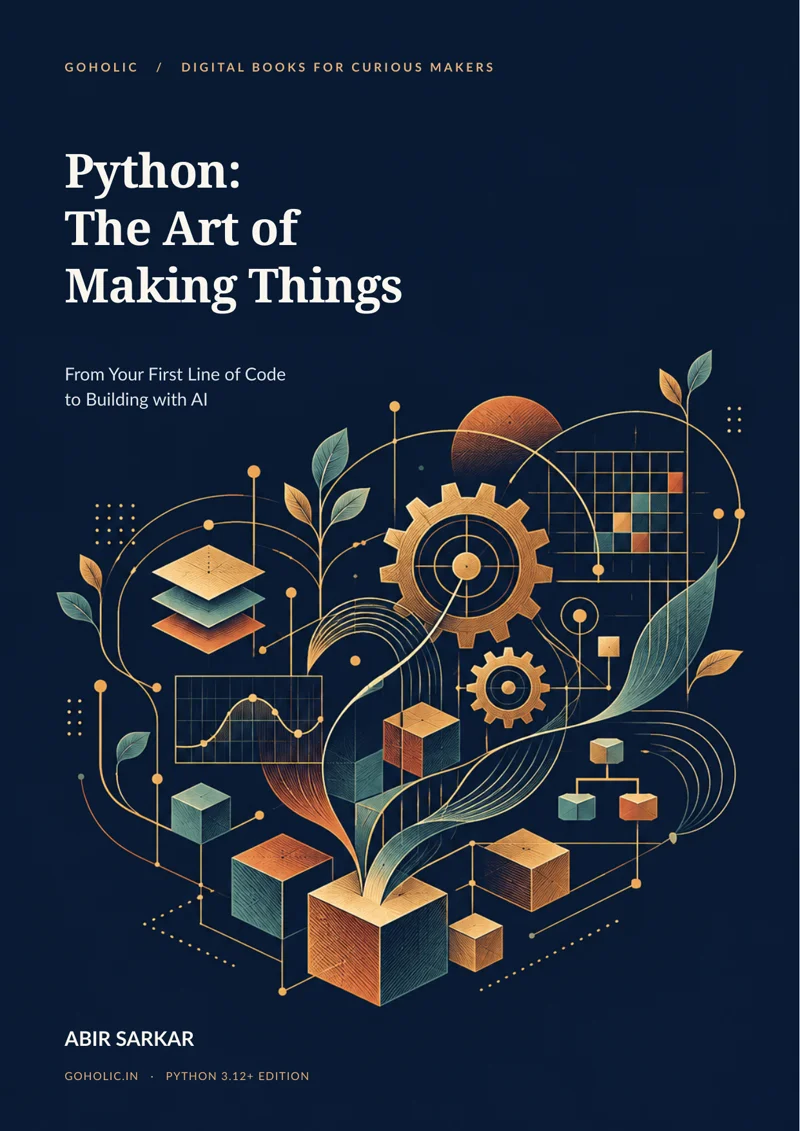
Digital PDF · First digital edition, November 2026
Python: The Art of Making Things
From Your First Line of Code to Building with AI
Python: The Art of Making Things by Abir Sarkar is a 120-page A4 digital PDF for beginners who want to write and read Python 3.12 by building. It costs ₹399. Nineteen chapters move from the first experiments to three projects, then introduce an LLM after you can inspect the code.
Who this book is for
This book is for a beginner who wants to write and read Python 3.12 by following a sequence of small experiments. It suits a reader who wants to understand program state, decisions, loops, collections, functions, files, and debugging before asking an AI assistant to write code.
Python: The Art of Making Things is not a job-placement programme or a data-science certificate. It is a beginner’s programming book built around Python 3.12 and three projects.
How to use a chapter
Read a chapter with Python 3.12 available, then run the small experiments and change the input. Early chapters make program state visible: values receive names, branches choose a path, and loops update counters or accumulators. Later chapters add lists, dictionaries, functions, files, CSV, JSON, modules, exceptions, and a systematic way to debug.
The three projects arrive after those pieces have names. On page 85, the Personal Expense and Receipt Ledger works with records and files. On page 91, the Climate and Greenhouse Sensor Investigator turns readings into questions you can test. On page 95, the Spaced-Repetition Study Deck uses stored state to decide what appears next.
Chapter 18, on page 98, introduces an LLM after you can read the code it proposes. The point is practical: ask for help, inspect the answer, and keep responsibility for what runs. Appendices A–E add hints, an AI learning guide, a glossary, a Python 3.12 cheat sheet, and references on pages 106–118.
Read part of the book here
The public sample contains pages 1–6 only: the cover, copyright page, contents, and the opening of the introduction. It is not the paid 120-page PDF and does not include the project chapters.
What you leave with
- A working vocabulary for reading Python 3.12 programs
- Three projects that combine the earlier chapters
- A grounded way to use an LLM after you can inspect its code
How the PDF arrives
After verified payment, the book and seller-issued invoice are delivered by email and available from the order confirmation page. If payment succeeds and delivery fails, email webdev.abir@gmail.com.
Questions before buying
What is the price of Python: The Art of Making Things?
Python: The Art of Making Things costs ₹399. Checkout charges that amount.
What format will I receive?
Python: The Art of Making Things is a 120-page A4 digital PDF for personal use. There is no physical copy.
What does the public sample include?
The public sample contains pages 1–6 only: the cover, copyright page, contents, and the opening of the introduction. It is not the paid 120-page PDF and does not include the project chapters.
Does the book assume prior practice?
No prior Python practice is assumed. The sequence begins with what a program does and how to run the first experiments before it introduces larger pieces.
What is the refund rule after delivery?
Once the book has been delivered by email, change-of-mind cancellation or refund is not normally available, except where law requires otherwise. If the file is unavailable, corrupted, or cannot be accessed, support first restores access. If that fails, the payment is reviewed for a refund.
Contents
- What a Program Actually Doesp. 7
- Running Your First Experiments in Python 3.12p. 14
- Values, Variables, and Program Statep. 21
- Text, Input, and Conversation with a Programp. 26
- Comparisons, Booleans, and Branchingp. 32
- Compound Decisions and Edge Casesp. 38
- Loops, Counters, and Accumulatorsp. 44
- Indefinite Loops, Stopping Conditions, and State Tracesp. 49
- Lists, Tuples, and Ordered Datap. 54
- Dictionaries, Sets, and Choosing Representationsp. 59
- Functions, Parameters, and Return Valuesp. 65
- Scope, Decomposition, and Testing Small Toolsp. 69
- Files, CSV, JSON, and Persistent Datap. 75
- Modules, Exceptions, and Systematic Debuggingp. 79
- Project 1: Personal Expense and Receipt Ledgerp. 85
- Project 2: Climate and Greenhouse Sensor Investigatorp. 91
- Project 3: Spaced-Repetition Study Deckp. 95
- Working with LLMs as a Learning Partnerp. 98
- Choosing Your Next Directionp. 103